
Every business wants to reach customers who are interested in its products or services. However, attracting the right audience online can be challenging, especially when multiple businesses compete for attention.
When someone searches for a service on Google, they may already be comparing providers or preparing to make an enquiry. This creates an opportunity for businesses to connect with potential customers through paid search advertising.
Google Ads services in Nagercoil can help local businesses advertise their products and services to relevant audiences, manage advertising budgets, and measure customer enquiries.
Whether you operate a construction company, dental clinic, educational institution, retail shop, or professional service business, understanding how Google Ads works can help you make informed advertising decisions.
This guide explains the different types of Google Ads campaigns, keyword targeting, budgeting, conversion tracking, and strategies for local businesses in Nagercoil and Kanyakumari district.
What Are Google Ads Services?
Google Ads is an online advertising platform that allows businesses to promote their products and services through Google’s advertising network.
Businesses can create campaigns based on goals such as generating leads, increasing website visits, building awareness, or encouraging purchases.
Google Ads services typically involve planning, creating, managing, and improving advertising campaigns.
Common activities include:
- Keyword research and campaign planning.
- Audience and location targeting.
- Advertisement copywriting.
- Campaign setup and management.
- Landing page recommendations.
- Conversion tracking.
- Budget and bidding management.
- Performance analysis and optimisation.
The purpose is not simply to generate clicks. A well-managed campaign should focus on attracting relevant visitors and encouraging meaningful business actions.
Why Should Businesses in Nagercoil Consider Google Ads?
Customers in Nagercoil frequently use online search to explore products and services.
For example, someone planning to build a house may search for construction services, while another person may search for a nearby dental clinic or training institute.
Google Ads can help businesses advertise in connection with relevant searches.
1. Reach Customers Searching for Services
Search advertising allows businesses to target keywords related to their offerings.
For example, a construction company may advertise for relevant house construction searches, while a training institute may target searches for its courses.
This approach can help connect advertising with existing customer interest.
2. Target Relevant Locations
Businesses can configure geographic targeting according to their service areas.
A company operating in Nagercoil may choose to target relevant locations within Kanyakumari district.
However, location targeting is not a guarantee that every impression will come from someone physically inside the selected area. Advertisers should review location settings and performance regularly.
3. Control Advertising Budgets
Google Ads allows advertisers to set campaign budgets and select bidding strategies.
Businesses can begin with a budget that suits their financial situation and review performance before making changes.
Advertising costs depend on factors such as competition, keywords, targeting, campaign settings, and ad performance.
4. Measure Customer Actions
With appropriate tracking, businesses can measure actions such as enquiry-form submissions, phone calls, purchases, or appointment requests.
These measurements can help businesses evaluate whether advertising is contributing to their goals.
5. Support Different Business Objectives
Google Ads is not limited to website traffic.
Depending on campaign eligibility and configuration, advertisers can focus on leads, sales, brand awareness, or other supported objectives.
Choosing the right objective is an important part of campaign planning.
Types of Google Ads Campaigns
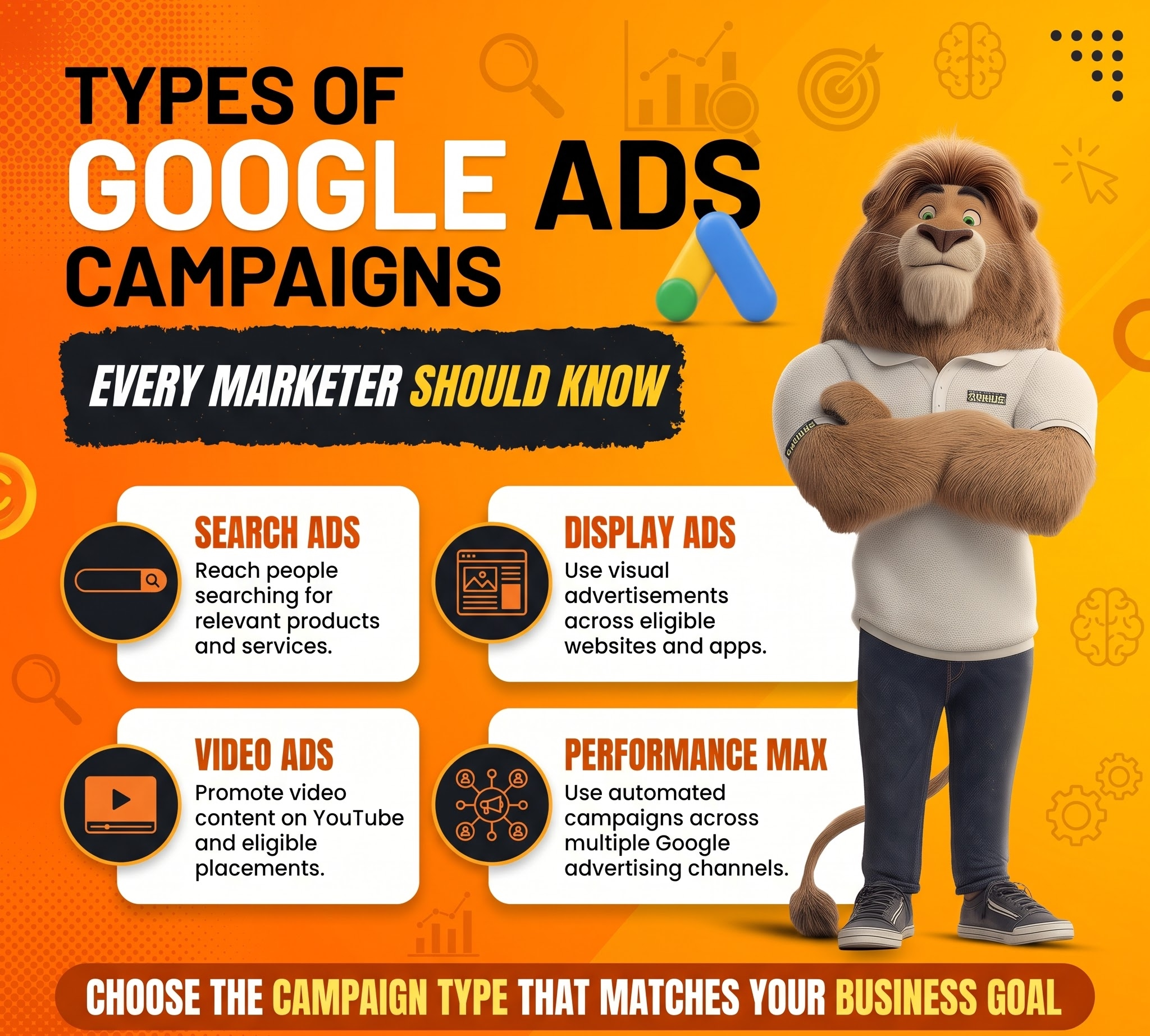
Google Ads provides several campaign types designed for different advertising objectives.
Google Search Ads
Search campaigns primarily use text advertisements that can appear in connection with relevant Google searches.
They can be useful when potential customers are actively looking for a product or service.
For example, a business offering home renovation services may want to reach people searching for renovation contractors.
Search campaigns are often worth evaluating when the primary objective is generating relevant enquiries.
Google Display Ads
Display campaigns use visual advertisements that can appear across participating websites, apps, and Google-owned properties.
They may be suitable for increasing awareness, reaching relevant audiences, or reconnecting with eligible previous website visitors.
Display advertising requires suitable creative assets and careful audience planning.
YouTube Video Ads
Video campaigns allow businesses to promote video advertisements on YouTube and other eligible placements.
These campaigns can help introduce services, explain products, or build awareness.
Video advertising may be useful when demonstrations, explanations, or visual storytelling support the business objective.
Performance Max Campaigns
Performance Max is a goal-based campaign type that can use multiple Google advertising channels within a single campaign.
It uses automated systems to help optimise advertising toward selected conversion goals.
Businesses considering Performance Max should ensure that conversion tracking, campaign assets, business goals, and budget expectations are appropriately configured.
The best campaign type depends on the business objective rather than the popularity of a particular advertising format.
How Google Search Ads Work
Google Search Ads connect advertisements with searches that may be relevant to the advertiser’s products or services.
A typical campaign involves several important elements.
Keyword Selection
Advertisers select keywords associated with their products, services, or customer needs.
For example, a business might research searches related to its service category and operating location.
Keywords should be selected according to relevance, commercial intent, available data, and campaign goals.
Advertisement Copy
Advertisements should communicate what the business offers and give users a reason to explore the service.
Effective ad copy is specific, relevant, and consistent with the destination page.
Avoid exaggerated claims or promises that the business cannot substantiate.
Landing Page
When someone clicks an advertisement, they should reach a page that provides information relevant to their search.
A clear landing page helps visitors understand the offer and decide whether to enquire.
Bidding and Budget
Google Ads uses bidding systems to determine how advertisers compete for eligible advertising opportunities.
The advertiser’s bidding strategy, budget, relevance, and other auction factors can affect delivery and costs.
A larger budget does not automatically guarantee better business results.
Keyword Research and Audience Targeting
Keyword research is an important part of planning Google Ads services in Nagercoil.
The goal is to identify searches that are relevant to the business and likely to attract the intended audience.
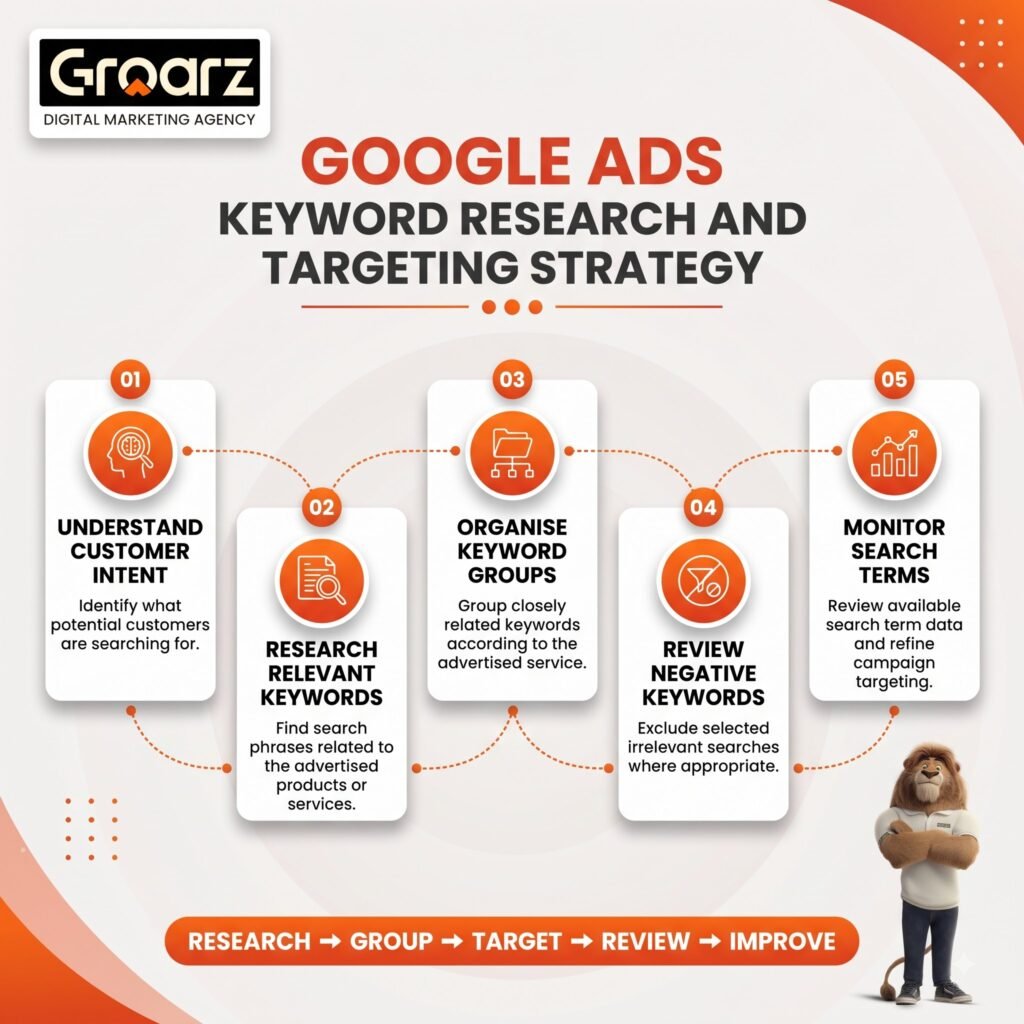
Understand Search Intent
Not every search indicates the same level of interest.
Some people want general information, while others are comparing providers or preparing to contact a business.
A campaign focused on enquiries should consider keywords that closely match the services being offered.
Use Relevant Keyword Groups
Related keywords can be organised into focused ad groups.
For example, a construction business may separate advertisements for new house construction, renovation, and architectural planning when those services require different messages or landing pages.
Review Search Terms
Search term reports can help advertisers understand which searches are triggering their advertisements, subject to reporting limitations.
Reviewing this information can identify irrelevant searches and opportunities for improvement.
Use Negative Keywords
Negative keywords help prevent advertisements from appearing for selected unwanted searches.
For example, a service business that does not provide employment opportunities through its advertising campaign may want to exclude irrelevant job-related searches.
Negative keywords should be selected carefully to avoid blocking useful traffic.
How Google Ads Can Generate Business Enquiries
Generating enquiries requires more than launching an advertisement.
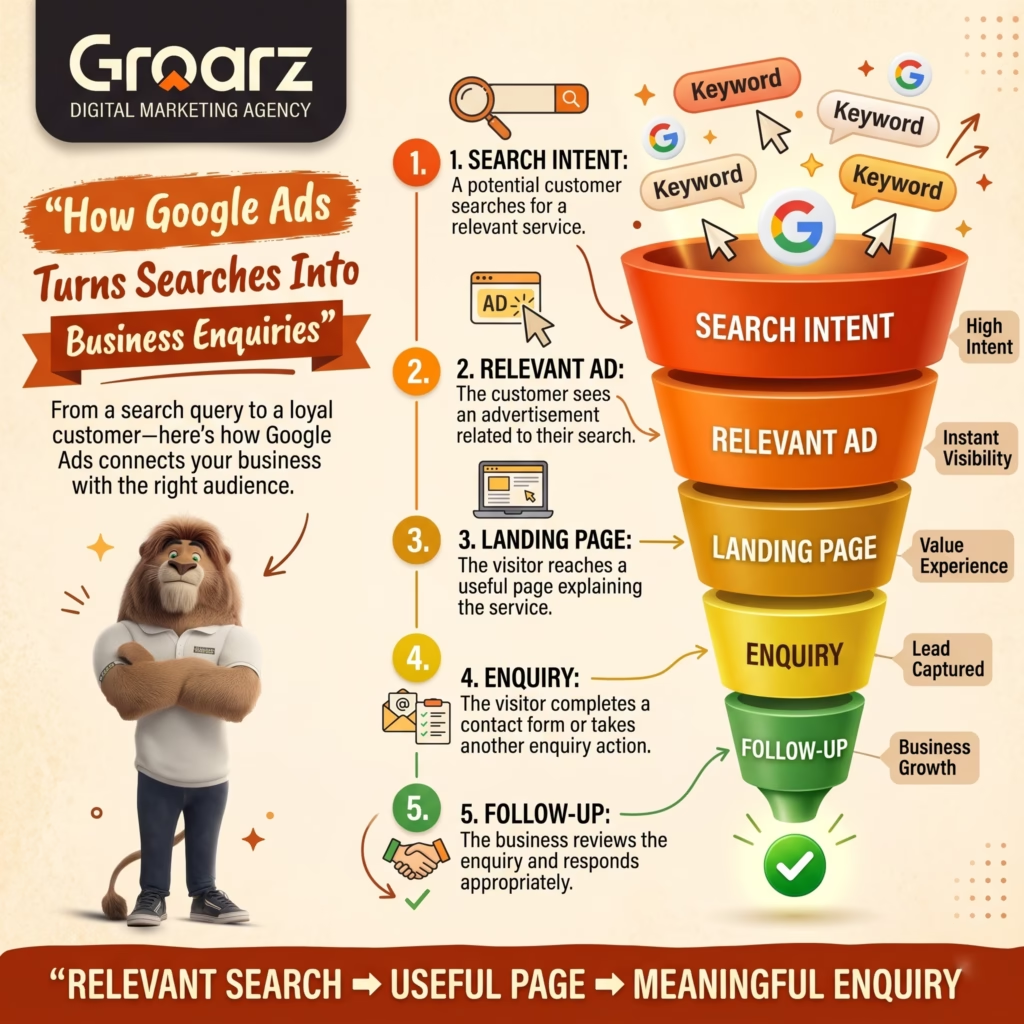
A successful lead-generation process should connect the customer’s search, advertisement, landing page, and follow-up experience.
Step 1: Identify the Right Audience
Understand which customers need the service and where the business can genuinely serve them.
Step 2: Choose Relevant Searches
Focus on keywords that reflect the services being advertised.
Step 3: Write Clear Advertisements
Explain the service accurately and provide a relevant reason for users to continue.
Step 4: Direct Visitors to a Useful Landing Page
The destination page should explain the service and provide clear contact or enquiry options.
Step 5: Track Meaningful Actions
Measure relevant enquiries where tracking is available and appropriately configured.
Step 6: Review Lead Quality
Not every enquiry becomes a customer.
Businesses should review whether enquiries are relevant, whether follow-up is effective, and whether advertising costs are commercially reasonable.
This approach helps connect campaign activity with business outcomes.
Landing Pages and Conversion Tracking
A landing page is the page visitors reach after clicking an advertisement.
It plays an important role in helping visitors understand the advertised service.
What Makes a Useful Landing Page?
A landing page should include:
- A clear headline describing the service.
- Information that matches the advertisement.
- Relevant service benefits and details.
- Accurate business information.
- Easy-to-use contact or enquiry options.
- A mobile-friendly layout.
- Appropriate privacy information where personal data is collected.
Avoid sending visitors to an unrelated page that does not address their original search.
What Is Conversion Tracking?
Conversion tracking helps advertisers measure selected actions taken after interactions with advertisements.
Depending on the campaign, these actions may include form submissions, phone calls, purchases, or other meaningful events.
Tracking should be configured carefully and tested before the data is used to evaluate performance.
Businesses should also follow applicable privacy and consent requirements when collecting or processing user information.
Understanding Google Ads Budgets and Costs
One of the most common questions about Google Ads services in Nagercoil is how much advertising costs.
There is no single advertising budget that suits every business.
Costs depend on several factors, including:
- Industry and competition.
- Keyword selection.
- Geographic targeting.
- Campaign type.
- Bidding strategy.
- Advertisement relevance.
- Landing page experience.
- Customer acquisition goals.
Advertising Spend vs Management Fees
Businesses should distinguish between the amount paid to Google for advertisements and any fees charged by an agency for campaign management.
The advertising budget funds campaign delivery.
Management fees, where applicable, cover services such as planning, setup, monitoring, reporting, and optimisation.
Ask for a clear explanation of both before approving a campaign.
How Should a Business Set Its Budget?
Start by identifying the value of a relevant enquiry or customer.
Then consider the amount the business can reasonably invest while testing and improving the campaign.
Avoid selecting a budget solely because another business uses it.
Review actual campaign performance and lead quality before increasing spending.
Common Google Ads Mistakes to Avoid
Several mistakes can reduce advertising efficiency.
Targeting Irrelevant Keywords
Broad or poorly selected keywords may attract visitors who are not interested in the advertised service.
Review keyword relevance and search terms regularly.
Ignoring Negative Keywords
Without suitable exclusions, campaigns may appear for unwanted searches.
Negative keywords can help improve targeting when used appropriately.
Sending Visitors to Unrelated Pages
An advertisement about a specific service should lead to a page that explains that service.
An unrelated destination can create confusion and discourage enquiries.
Focusing Only on Clicks
Clicks indicate interaction with an advertisement, but they do not necessarily represent business value.
Review meaningful conversions and lead quality.
Making Changes Without Enough Evidence
Frequent changes based on limited data can make campaign performance difficult to evaluate.
Use an organised review process and consider the available evidence before making significant adjustments.
Ignoring Mobile Experience
Visitors should be able to read the landing page, navigate it, and submit an enquiry from a mobile device.
Using Unsupported Claims
Advertisements should accurately represent the business.
Avoid fabricated testimonials, unrealistic promises, or guarantees that cannot be verified.
How to Measure Google Ads Performance
Campaign performance should be evaluated against the business’s objectives.
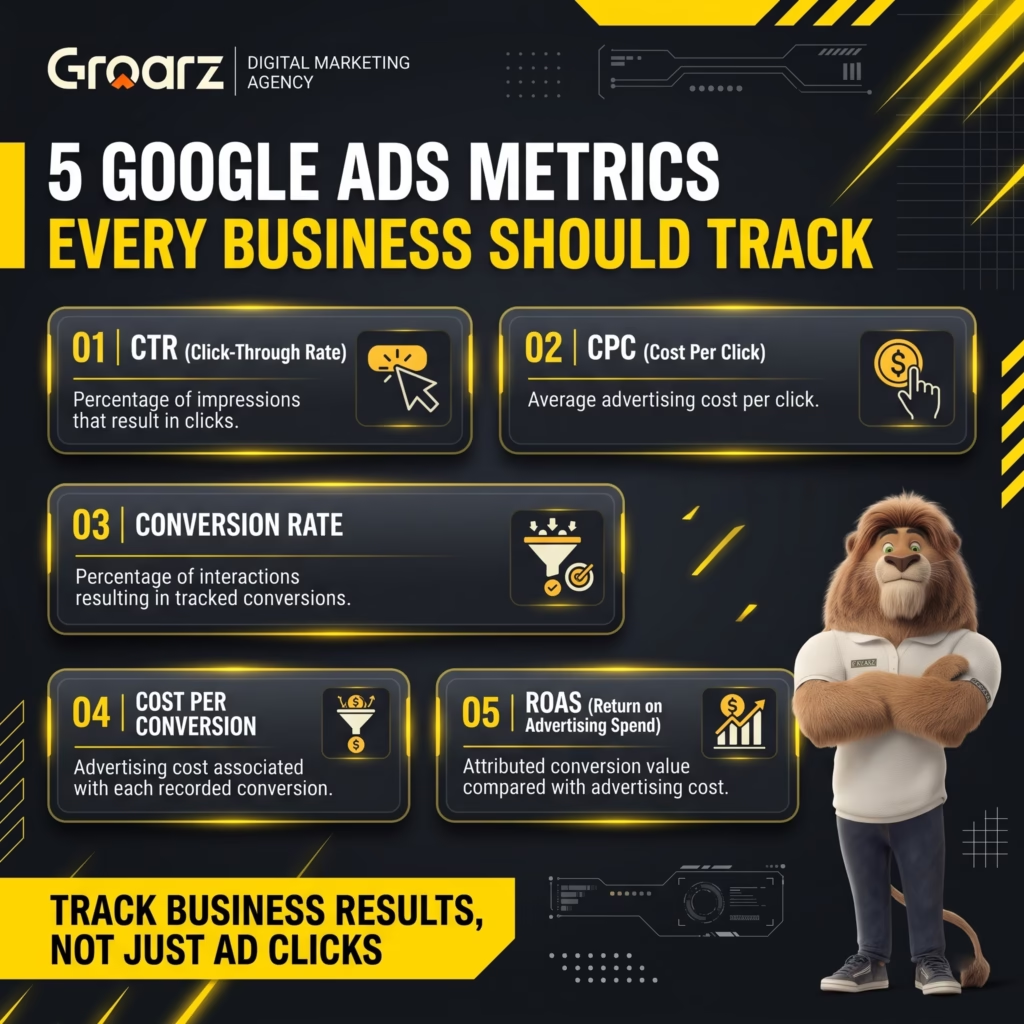
Click-Through Rate
Click-through rate, or CTR, measures the percentage of impressions that result in clicks.
It can help advertisers evaluate engagement, but a high CTR does not automatically mean a campaign is profitable.
Cost Per Click
Cost per click, or CPC, indicates how much an advertiser pays per click on average.
This metric helps with cost analysis but should be considered alongside conversions and lead quality.
Conversion Rate
Conversion rate measures the proportion of eligible interactions that result in a tracked conversion.
It helps businesses understand whether visitors are completing the intended actions.
Cost Per Conversion
Cost per conversion helps advertisers understand the advertising cost associated with each recorded conversion.
However, conversion quality also matters.
Return on Advertising Spend
Return on advertising spend, or ROAS, compares attributed conversion value with advertising cost.
It is most useful when conversion values are measured reliably.
For lead-generation campaigns, businesses may also need to review how many enquiries become qualified leads and paying customers.
How to Choose a Google Ads Strategy for Your Business
A practical Google Ads strategy begins with a clear business goal.
For example, a local service provider may want appointment enquiries, while an online retailer may focus on product purchases.
Before launching a campaign:
- Identify the primary advertising objective.
- Define the intended audience and service area.
- Research relevant keywords and campaign options.
- Prepare suitable advertisements and landing pages.
- Configure and test conversion tracking.
- Set an appropriate advertising budget.
- Launch the campaign and monitor results.
- Improve targeting, advertisements, and landing pages using performance data.
Businesses considering Google Ads management services should also ask how campaign performance will be reported and who will retain ownership of the advertising account.
Conclusion
Google Ads can help businesses connect with relevant audiences through paid advertising. However, campaign performance depends on careful planning, suitable targeting, useful landing pages, accurate conversion tracking, and regular optimisation.
For businesses in Nagercoil and Kanyakumari district, understanding these elements can make it easier to plan advertising activities around genuine business goals.
If you are exploring Google Ads services in Nagercoil, contact Groarz to discuss your business requirements and available digital marketing options.
Call Groarz at +91-7904759271 or visit the Groarz website to request a free estimate.
Frequently Asked Questions About Google Ads Services in Nagercoil
1. What are Google Ads services in Nagercoil?
Google Ads services in Nagercoil involve planning, creating, managing, and optimising paid advertising campaigns for businesses targeting relevant customers. Services may include keyword research, campaign setup, ad copywriting, budget management, and conversion tracking.
2. How can Google Ads help small businesses?
Google Ads can help small businesses reach relevant audiences through paid advertisements. With suitable targeting and tracking, businesses can evaluate website visits, enquiries, and other meaningful actions.
3. How much do Google Ads cost in Nagercoil?
Costs vary according to competition, keywords, campaign settings, targeting, and advertising goals. Businesses should separate their advertising spend from any agency management fees.
4. What is the difference between Google Ads and SEO?
Google Ads provides paid advertising opportunities, while SEO focuses on improving organic search visibility. Businesses may use either approach or combine them according to their goals.
5. Which Google Ads campaign is best for local businesses?
The most suitable campaign depends on the objective. Search campaigns may be useful for reaching people actively searching for services, while other campaign types can support awareness, sales, or additional advertising goals.
6. Can Google Ads generate leads for service businesses?
Google Ads can support lead generation when advertisements reach relevant audiences and direct visitors to useful landing pages. Results depend on targeting, competition, the offer, and the customer experience.
7. What is conversion tracking in Google Ads?
Conversion tracking measures selected customer actions associated with advertising interactions. These may include form submissions, purchases, phone calls, or other actions relevant to the business.
8. Do businesses need a landing page for Google Ads?
Advertisements need an appropriate destination. A dedicated landing page can be useful when it provides information closely related to the advertisement and makes the next action clear.
9. How can I measure Google Ads campaign success?
Review metrics such as conversions, cost per conversion, conversion value, and lead quality. The most useful metrics depend on the business objective.
10. How can Groarz help with Google Ads?
Businesses can contact Groarz to discuss their paid advertising goals, target audience, budget considerations, and campaign management requirements. The proposed services and deliverables should be confirmed before starting.